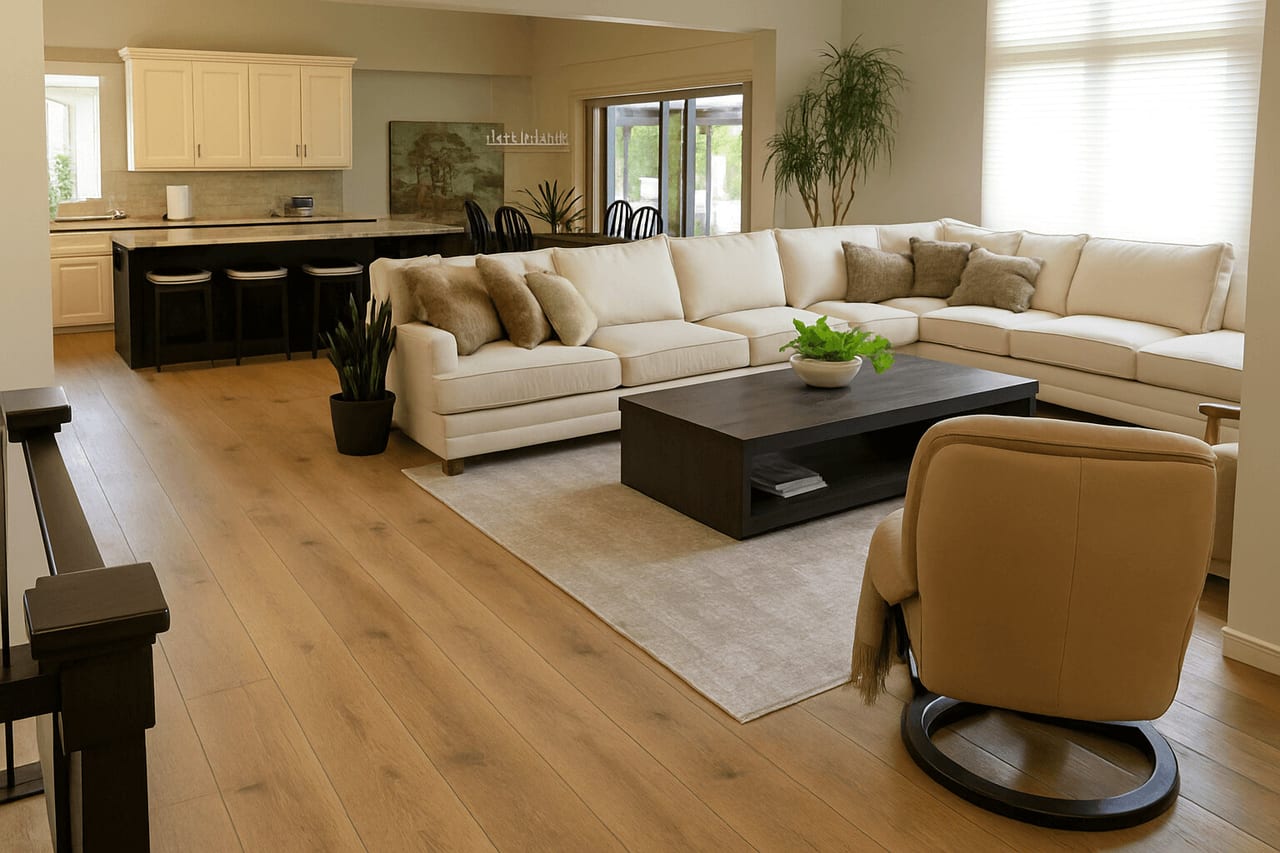
| Solid vs Engineered |
Solid is one piece of hardwood top to bottom, and it can be refinished several times over its life. Engineered is a genuine hardwood wear layer bonded to a stable core. An engineered floor with a thick enough wear layer can usually be refinished at least once, sometimes more. Ask us and we will tell you which yours is. |
Solid for many main levels. Engineered for stability over concrete, basements, and wider planks. |
Homes here deal with real humidity swings between seasons, and engineered handles those shifts better than solid below grade and over the concrete slabs common in this area. Either way you are protected against taste: a stain that felt current years ago can be sanded away and redone in a completely different color. Considering refinishing an existing engineered floor? The answer depends on the wear layer, and we can tell you once we see it. |
| Prefinished vs Site-finished |
Prefinished boards arrive with their finish already applied at the mill, cured under UV light in four to seven coats fortified with aluminum oxide. That is a coat count and a level of control no jobsite matches. Site-finished floors are installed raw, sanded flat in your home, and coated in place, so the finish runs unbroken across every board joint instead of dropping into the small bevel at each edge of a prefinished board. That bevel is engineering, not styling: a prefinished floor is never sanded flat after installation, so the groove absorbs the small height differences between boards. |
Prefinished when you want to walk on the floor the day it goes down, with no sanding dust and no finish odor in the house. Site-finished when you need an exact stain match to existing floors, a custom color, or one unbroken surface through doorways and stairs. |
Many of our customers choose prefinished, and what we've seen is that the schedule decides it as often as the finish does: a site-applied finish needs days before furniture and rugs come back, and with some finishes it is weeks. Worth knowing: the waiting-time difference between the two site-applied finish families, oil-based and water-based, is bigger than the difference between site-finished and prefinished. If you are matching or extending an existing floor, site-finished is usually the right call, and it is work our own crew does. Either way we will tell you what the finish you are choosing means for the week of installation, and for the year after. |
| Species and Look |
Species determines color, grain pattern, hardness, and how well the floor hides daily scratches from pets and traffic. Hardness and concealment are different things: a dark floor can be hard and still show every scratch, because a scratch exposes the lighter wood underneath. |
Red oak is the classic Kansas City metro floor, and still the one most people picture: warm, forgiving grain that hides wear well. Hickory is the hardest common domestic species, right for active households that want rustic character. Maple suits calm modern rooms, with one honest caveat: its tight, uniform grain shows scratches more readily than oak. Walnut is chosen for its color, not its toughness. It is softer than oak, so it belongs in lower-traffic rooms that deserve its depth. |
White oak is the most requested species here right now; it is popular enough that we built a page for it. We carry White Oak, Red Oak, Hickory, Walnut, Maple, and more, in looks from golden oak to French oak character, and if you have a species in mind, ask us. We can usually source it. |
| Grade and Character |
Select grade is clean and uniform. Character grade includes natural knots and variation for a warm, lived-in look. |
Select for calm, modern spaces. Character for rustic, farmhouse, or active homes where variation hides wear. |
In homes with kids, pets, and high traffic, Character grade is often the smarter long-term choice: natural variation hides day-to-day wear far better than a clean, uniform floor that shows every mark. We'll put samples of both in front of you so you can see the difference in person. |
| Plank Width and Layout |
Wider planks (5–8"+) look premium but require precise subfloor prep and careful layout planning. |
Great for open floor plans. Best when direction, transitions, and stairs are planned so the floor feels continuous. |
Wide-plank White Oak is one of the most popular floors we install here, and it rewards careful prep. We check moisture and flatness before recommending a width, and we plan layout direction early so the floor runs cleanly through open-plan spaces and into adjacent rooms. |
| Finish and Sheen |
Matte and satin sheens show day-to-day wear far less than high gloss. Texture can help conceal surface scratches within the grain. |
Most Kansas City metro homes choose matte or satin for a clean look and lower maintenance. |
For active households, especially those with dogs, our most recommended combination is wire-brushed texture with a matte finish: the texture hides surface scratches within the grain, and matte shows footprints and dust far less than gloss. And when styles change, a refinish can take the same boards from a dated gloss to a clean modern matte without replacing the floor. We can show you samples before you decide. |